Insights
The Store, the Sales Call and the Contact Center Are Becoming One Conversation
Buyers move between your website, phone line and sales team in one purchase. A digital sales room joins them. The four leak points where buyers drop off, and a staged plan to seal them.
Your buyers already move between your website, your phone line and your sales team in a single purchase. The companies that win the next few years will make those three feel like one conversation, and a digital sales room is the simplest way to start.
Picture a buyer today. She builds a cart on your site, calls with a question, and the agent can't see what she was looking at. A salesperson follows up a day later with a quote built from scratch. Every handoff loses a little context, and every repeat costs a little trust.
A digital sales room joins those moments. The buyer, your expert and the cart or quote sit in one live session inside your store, and everything said and shown flows back into your systems for the next conversation.
First, the terms
- Digital sales room (DSR): a live, shared space inside your online store where a buyer and your expert talk by video, browse products together, build a cart or quote, and close the order.
- Guided shopping: the consumer version of a digital sales room. An expert walks a shopper through products live, the way a good store associate would.
- Ecommerce platform: the system behind your online store that holds products, prices, carts, orders and returns. Shopware is one example.
- CRM (customer relationship management): the system that holds the customer record: who they are, what they've bought, open deals and past conversations.
- Contact center platform (CCaaS, contact center as a service): the cloud software that routes calls, chats and messages to your service and sales agents.
- Agent assist: AI that helps a person during a live conversation by suggesting answers, pulling up the customer's history and writing the notes afterward.
- Context: everything already known about this customer and this purchase. The goal is that it follows the buyer, so nobody asks twice.
Why the handoffs lose sales
Buyers want to do most of the work themselves, but they still want a person at the moments that matter. The gap between those two is where context, and sales, get lost.
- Buyers start without you. In Gartner's 2025 survey, 67% of B2B buyers said they prefer a sales-rep-free experience, and 45% used generative AI during a recent purchase. (Digital Commerce 360)
- But they still want a person to confirm. The same research found 69% of B2B buyers turn to sales reps to validate what AI told them. (Gartner via Business Wire)
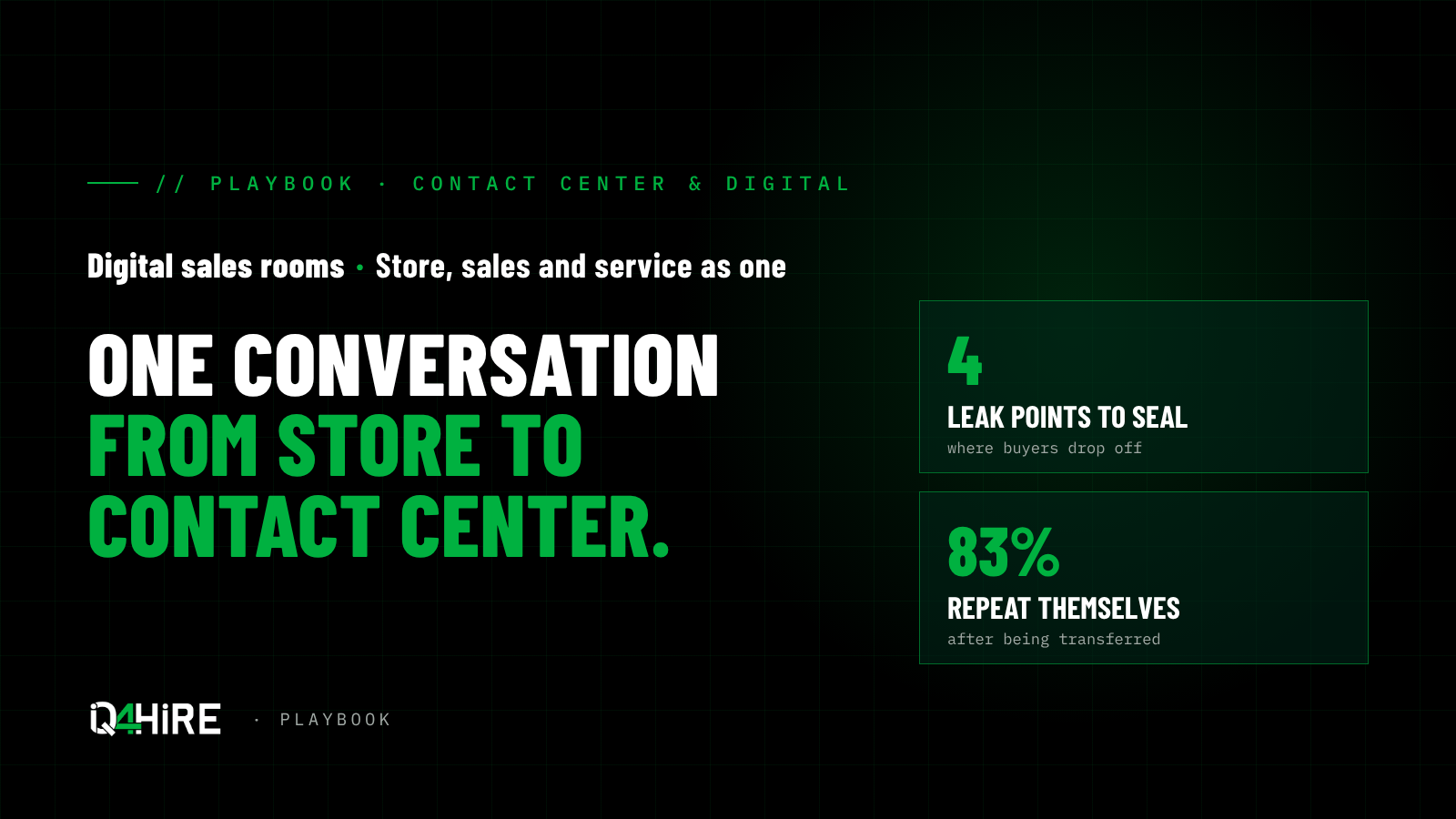
- And the handoff usually breaks. In Five9's 2026 research, 96% of business decision-makers said their handoffs preserve context, while 83% of customers said they still have to repeat themselves. (CMSWire)

In a legacy setup, each system hands the buyer to the next one empty-handed, and each handoff is a chance to lose them. In an integrated setup, the cart, quote and history move with the buyer.
The four leak points and how to seal them
Every business leaks at different rates, but almost every business leaks at these four points.
| Leak point | What the buyer feels | What seals it | What has to connect |
|---|---|---|---|
| 1. Store to question | "I have to explain what I was looking at." | Ask from the product page; the cart and pages viewed come along | Ecommerce platform and contact center |
| 2. Question to expert | "Why am I starting over?" | The expert sees browsing, cart and past orders before saying hello | Ecommerce, CRM and the digital sales room |
| 3. Expert to quote | "I'll wait a day for a price I could have had now." | Pricing and terms agreed live in the room, on the real catalog | Digital sales room and ecommerce (quotes, contract pricing) |
| 4. Quote to callback | "I already told someone all this." | The callback lands with the session, quote and open questions | CRM and contact center, with AI summaries |
Start by finding your worst leak. Ask your agents which question they hear most often after a buyer leaves the site, then fix that handoff first.
The lesson isn't to push buyers back to the phone. It's to make the moment they reach a person start where they already are: same cart, same quote, same history.
What a digital sales room is
A digital sales room puts the expert inside the store, rather than sending the buyer out of it. Shopware describes its version as a shared platform where sales teams and buyers connect, explore products, request quotes, negotiate pricing and place orders. (Shopware)
| Business buyers | Consumers | |
|---|---|---|
| What it replaces | The sales call, the emailed quote and the back-and-forth | The store associate, the product video and the "call us" button |
| What happens in the room | Walk through options, configure, agree pricing and terms, turn the quote into an order | A live demo, side-by-side comparisons, a cart built together |
| Best fit | Complex or configured products, contract pricing, several decision-makers | High-value or considered purchases: furniture, equipment, insurance, travel |
| What it should leave behind | A quote and order tied to the account, with notes for the next person | A cart or order tied to the customer, with what they asked about |
Because the session runs on the store itself, the products, prices and inventory are the real ones. Nobody rebuilds the quote afterward.
Connecting it: store, CRM and contact center
The value isn't the video call. It's that every system reads and writes the same customer history, so the buyer never starts over.

Each step hands the next one the full story. The store holds the cart and quote, the sales room adds the conversation, and the contact center picks it all up when the buyer calls back.
- Ecommerce platform: the products, prices, carts, quotes and orders. In the room, everyone works from the live catalog.
- CRM: the account, the deal and the history. Session notes and AI summaries land here, not in someone's inbox.
- Contact center: the callback, the chat or the AI agent. Routing can send a returning buyer to the expert they met, and the agent sees what was discussed.
- One platform for video, phone and contact center: in the U.S., Shopware's digital sales rooms run their video on Zoom. A company on Zoom Phone and Zoom Contact Center keeps the session, the calls and the customer history on one platform.
Where AI fits
AI makes the expert's time count at three moments around the session.
- Before the session: AI pulls together what the buyer browsed, what's in their cart, past orders and open quotes, so your expert walks in knowing the story.
- During the session: agent assist suggests the right product, answer or offer, and checks stock and pricing live.
- After the session: AI writes the summary, updates the CRM and the quote, and schedules the follow-up.
- On the callback: when the buyer calls back next week, the contact center agent, or an AI agent, sees the session, the quote and the open questions, and picks up where the expert left off.
The last one is where most companies lose the sale today, and where a connected contact center earns its keep.
Who should start now, and how
Start where one conversation decides a large purchase:
- B2B sellers with quotes: configured products, contract pricing, several approvers on the buyer's side.
- Considered consumer purchases: furniture, equipment, vehicles, home improvement, travel.
- "Start online, finish by phone" businesses: life insurance, loans, financial products, anywhere a buyer begins an application and needs a person to finish it.
- Teams already on Zoom or Shopware: the pieces are already in place.
A staged plan keeps it low-risk:
- Pick one product line or segment where the average order is large and buyers already ask for help.
- Turn on the digital sales room for that segment and offer "talk to an expert" on those product pages.
- Connect the record: session notes, cart and quote flow into the CRM and the order system.
- Connect the contact center so a callback lands with the full history.
- Add AI for prep, summaries and follow-up, then measure conversion, order size and repeat contacts against the segment's baseline.
- Expand to the next segment on the results.
How IQ4hire helps
We connect the pieces most companies buy separately: the ecommerce platform, the CRM, the phone system and the contact center. IQ4hire is a Shopware partner and sources contact center and AI platforms, including Zoom, from more than 450 pre-vetted vendors. We help you pick the first segment, scope the connections, and measure the results, with no RFP and no cost to you.
Not sure where your contact center stands? The Contact Center AI Path Advisor asks 12 questions, including how your customers buy and where your orders and quotes live, and recommends a path with matched suppliers.
Sources
- Digital Commerce 360, Gartner: Two-thirds of B2B buyers prefer rep-free purchasing
- Gartner via Business Wire, 69% of B2B Buyers Turn to Sales Reps to Validate AI-Generated Insights
- CMSWire, Customers: The AI Handoff Is Broken
- Shopware, Digital Sales Rooms
- CMSWire, Zoom Launches Unified Context Layer for CX Agents