Insights
Buying Guide: Microsoft Licensing After the EA (CSP vs. MCA-E vs. EA)
Microsoft ended EA volume discounts for cloud and raised Microsoft 365 prices. How to choose between CSP, MCA-E and renewing your EA, and what you lose if you move.
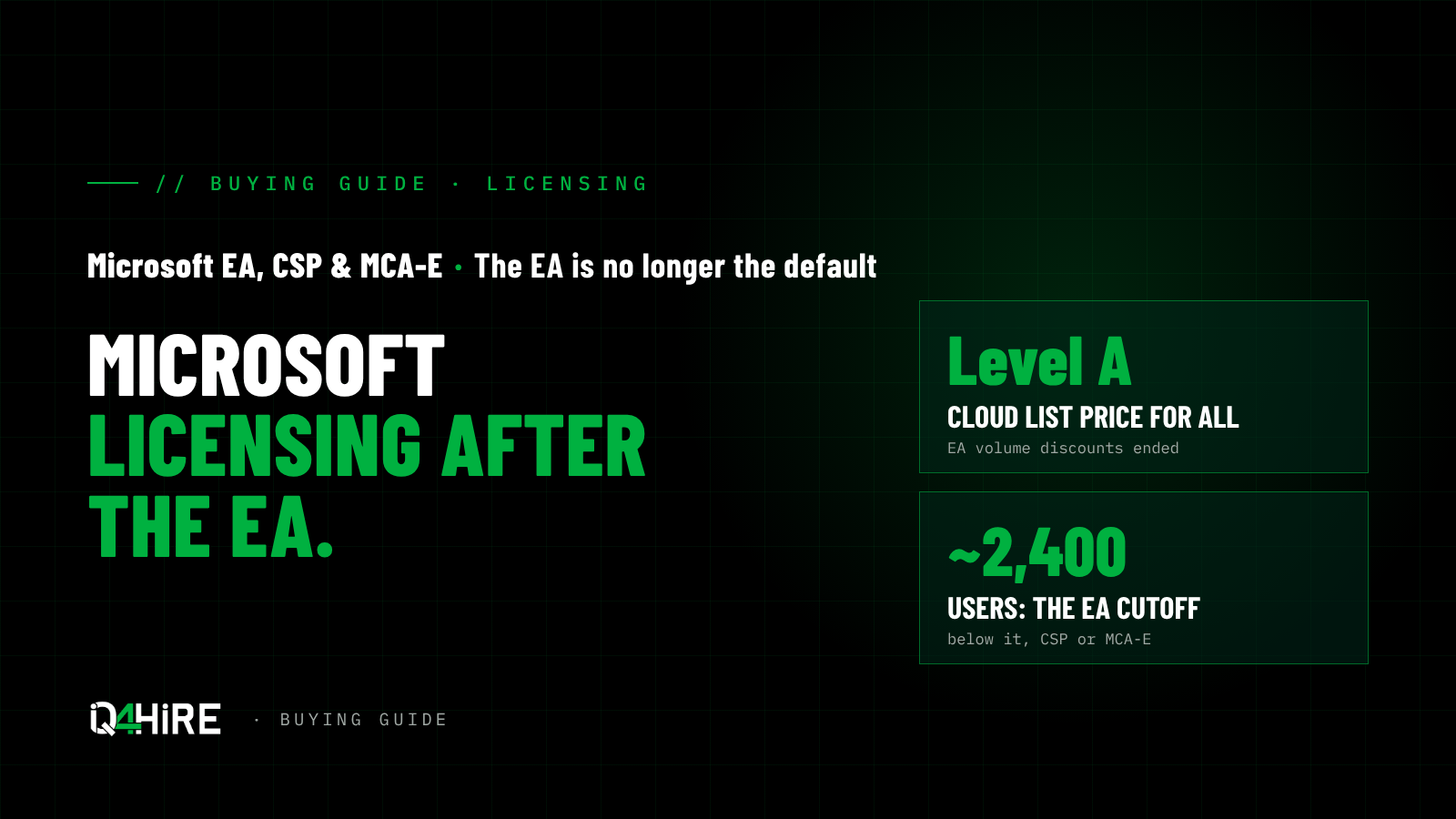
For most organizations under about 2,400 users, the Enterprise Agreement is no longer the default. The real choice is between CSP through a partner and MCA-E direct with Microsoft, and the right answer depends on who you want managing it, how you pay, and what EA benefits you'd lose.
This guide is for CIOs, CFOs and procurement leaders with a Microsoft EA renewal in the next 12–18 months, or a Microsoft 365 renewal priced after July 1, 2026.
First, the terms
- EA (Enterprise Agreement): Microsoft's traditional three-year volume licensing contract for large organizations, signed directly with Microsoft through a reseller.
- CSP (Cloud Solution Provider): Microsoft's partner program. You buy Microsoft licenses through a partner, who bills you monthly or yearly and supports you.
- MCA-E (Microsoft Customer Agreement for Enterprise): Microsoft's newer direct contract for large customers, with no fixed end date. It's replacing the EA for many organizations.
- SA (Software Assurance): an add-on to EA licenses that gives upgrade rights and other benefits. It doesn't exist in CSP the same way.
- True-up: the once-a-year count under an EA where you pay for any licenses you added during the year.
- Level A to D: the old EA volume discount tiers. Bigger customers (Levels B–D) paid less. Microsoft removed those discounts for cloud services.
- MACC (Microsoft Azure Consumption Commitment): a promise to spend a set amount on Azure, Microsoft's cloud, in return for discounts.
- CIS (Core Infrastructure Suite): a discounted bundle of Windows Server and System Center server licenses, sold only under the EA.
- Online Services: Microsoft's subscription cloud products, such as Microsoft 365, Dynamics 365 and Azure.
What changed
- Volume discounts on cloud services are gone. On November 1, 2025, Microsoft removed the Level B–D discounts for Online Services such as Microsoft 365, Dynamics 365 and Azure in the EA. Everyone pays Level A list price for cloud, though on-premises software discounts remain. (IT Asset Management)
- Smaller EAs are being steered out. Microsoft hasn't published a formal rule, but account teams now direct organizations below roughly 2,400 users to CSP or MCA-E at renewal. (Redress Compliance)
- Microsoft 365 list prices rose July 1, 2026. Increases ran from about 9% to 25% depending on the plan, and existing customers see them at their next renewal after that date, whatever the agreement. (heise, Office Watch)
- The two hit together. For large customers, losing the volume discount plus the list-price increase can add up to far more than the headline percentage. (UC Today)
The three routes
| Enterprise Agreement (EA) | MCA-E (direct) | CSP (through a partner) | |
|---|---|---|---|
| Who it's for | Roughly 2,400+ users with on-premises and cloud mix | Large, Azure-heavy organizations comfortable managing Microsoft directly | Any size; most organizations under ~2,400 users |
| Term | Fixed three years | Evergreen agreement; 1–3 year subscriptions | Monthly, annual or three-year subscriptions |
| Discounts | Negotiated; cloud now at Level A list | Negotiated per subscription | List plus partner pricing and Microsoft CSP promotions |
| Billing | Annual, true-up once a year | Monthly or annual, direct from Microsoft | Monthly or annual, through the partner |
| Who supports you | Microsoft plus a Licensing Solution Partner | Microsoft directly | Your CSP partner first, escalating to Microsoft |
| Software Assurance | Included | Not offered the same way | Not offered the same way |
CSP and EA pricing for online services now land close together, and CSP carries some time-limited promotions that EA renewals don't. (CloudServus)
How to decide
- Your size and mix. Above roughly 2,400 users with significant on-premises licensing, an EA may still be worth negotiating. Below it, plan for CSP or MCA-E.
- Your Azure commitment. If you have a Microsoft Azure Consumption Commitment (MACC), Microsoft is moving those customers toward MCA-E, so time the transition carefully. (CloudServus)
- Who you want in the room. MCA-E puts you directly with Microsoft. CSP gives you a partner that bills, supports and escalates for you.
- Cash flow and true-up. EA settles once a year; CSP and MCA-E bill monthly or annually. Finance needs to see the difference before you sign.
- Flexibility. Monthly and annual CSP terms let you reduce seats; three-year terms lock price but limit cuts.
- What you lose by leaving the EA (next section). Price it before you compare.
What you can lose moving off an EA
- Office rights from Software Assurance. If you moved from Office on-premises to Microsoft 365 on an EA, you may hold Office Professional Plus rights through a "From SA" discount. CSP doesn't carry that over, which can leave a compliance gap. (SAMexpert)
- The Core Infrastructure Suite bundle. The CIS bundle of Windows Server Datacenter and System Center, with its discount, doesn't exist in CSP. (SAMexpert)
- Annual true-up. You pay for growth as it happens instead of once a year.
- The three-year price lock, unless you choose three-year subscriptions.
Questions to ask before you renew
- When does our EA expire, and has Microsoft said in writing whether it will renew?
- What will each route cost over three years, including the July 2026 list prices, on the same seat counts?
- Which Software Assurance benefits do we use today, and what happens to each one?
- Do we have a MACC, and how will it move?
- Who handles support and escalation on each route, and how fast?
- Can we reduce seats mid-term, and what does it cost?
- Should we renew early to hold current prices on anything still renewing at old rates?
Traps
- Renewing on autopilot at Level A list prices without testing CSP or MCA-E.
- Losing rights you didn't know you had (Office from SA, CIS), then buying them again.
- Locking a three-year term on seats you're about to cut.
- Comparing list prices only. Partner pricing, promotions and support levels differ; compare total cost on the same scope.
- Letting Microsoft set the timeline. Start 6–12 months before expiry.
How IQ4hire helps
IQ4hire sources Microsoft CSP licensing through Channel Exchange, part of ScanSource, and through Microsoft licensing providers in our portfolio. We don't have a product of our own to push. We quote CSP on your seat counts, lay out what renewing the EA or moving to MCA-E would cost on the same scope, and tell you which one wins for your size and mix, including when the answer isn't CSP.
If CSP wins, here's what you get through Channel Exchange:
- Transfers with a cost check. Licenses move over from an existing Microsoft agreement, retail purchases or another CSP, with a full cost analysis first.
- Licensing specialists. Microsoft licensing specialists on staff, plus Azure, security and Modern Work pre-sales guidance, at no extra cost.
- Escalation to Microsoft. US-based Tier 1–3 technical support, backed by a Microsoft Premier Support contract for faster escalation.
- More than Microsoft. Security, backup, IaaS and communications are available through the same relationship.
Sources
- IT Asset Management, Microsoft Pricing Changes: EA Customers Face Price Increases
- Redress Compliance, The Microsoft Enterprise Agreement in 2026
- heise, Microsoft significantly increases prices for Microsoft 365 from July 2026
- Office Watch, Microsoft Announces Global Microsoft 365 Price Increases
- UC Today, Microsoft 365 Prices Rise on 1 July
- CloudServus, EA to CSP in 2026: What IT Leaders Need to Know
- SAMexpert, Is the Microsoft Enterprise Agreement Still Worth It in 2026?