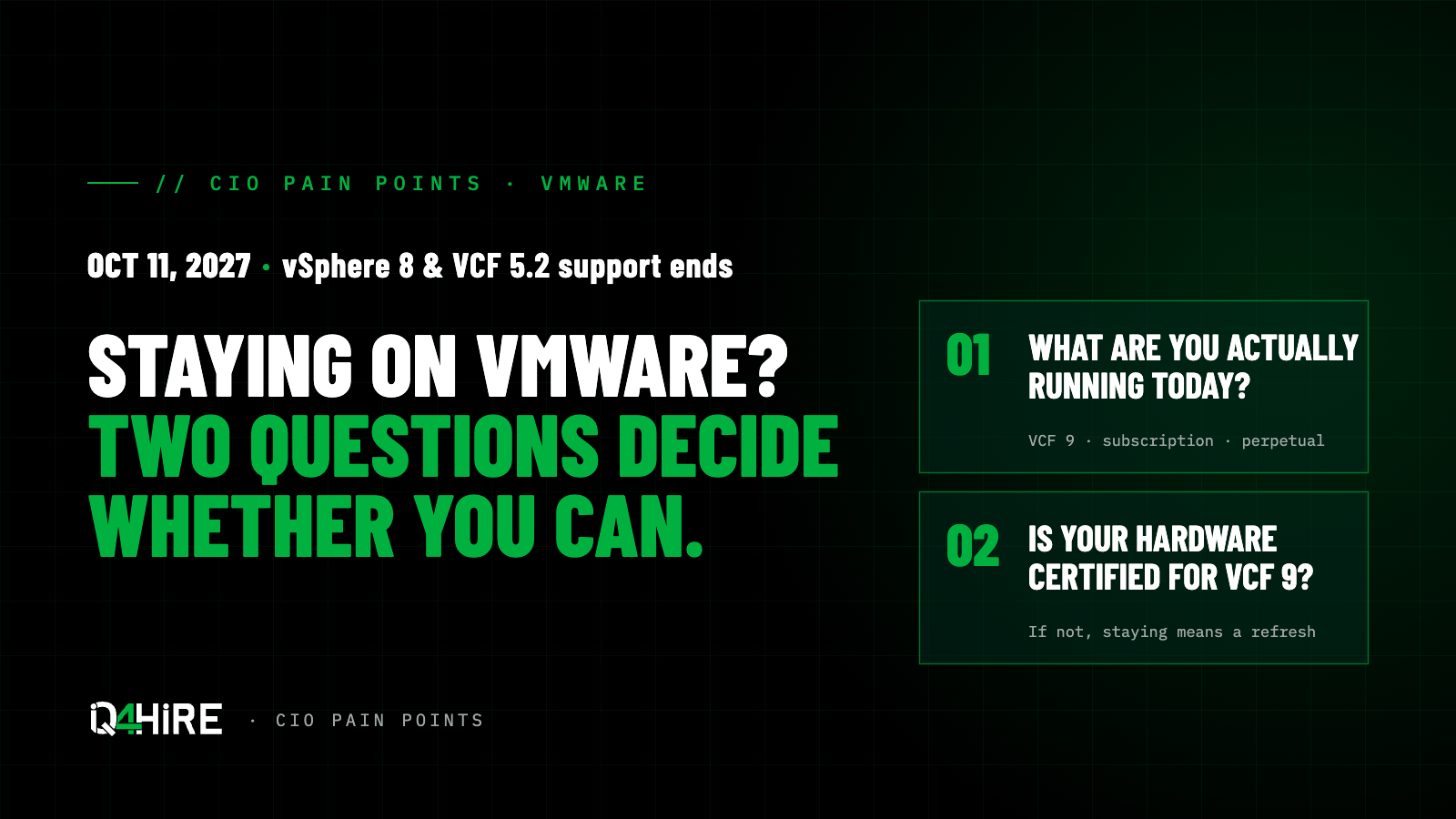
Staying on VMware? Two Questions Decide Whether You Can
vSphere 8 support ends Oct 11, 2027, so staying on VMware now means moving to VCF 9. What you run today and whether your hardware is certified decide whether you can.
Most CIOs I talk to have a quiet plan for VMware: renew, stay on-prem, deal with the rest later. That plan worked for fifteen years. It has about eleven months left.
Two dates end it. On October 11, 2027, Broadcom ends general support for vSphere 8, ESXi 8, vCenter 8, vSAN 8 and VCF 5.2. After that, perpetual license holders stop getting security patches. vSphere 7 already crossed that line on October 2, 2025. If you are still on it, you have been unpatched for over a year.
The second date is quieter. In January 2026, Broadcom stopped renewing most of its VMware cloud provider partners. Customers of those providers can't expand or renew, and March 2027 is the hard stop. If your VMware runs at a hosting partner, ask which tier they are in.
So "stay on VMware" now means "move to VCF 9." Whether you can do that on your own floor comes down to two questions.
Question 1: What are you actually running today?
Not what the contract says. What is installed, and whether it is still licensed and supported. In my conversations, most estates fall into one of four buckets:
- VCF 9 already: You are current. Your exposure is cost and renewal terms, not the platform.
- vSphere 8 or VCF 5.2 on an active subscription: You can upgrade, but the clock runs out Oct 11, 2027. Hardware decides how easily (Question 2).
- Perpetual licenses with active support: Same deadline. After it, you either subscribe or run without patches.
- Perpetual licenses with support lapsed, or vSphere 7: You are already unpatched. Broadcom will not renew lapsed support, and running unsupported software is now an audit and cyber-insurance problem, not just an IT one.
If you don't know which bucket you are in, that is the first finding. Many organizations run more than one.
Question 2: Is your hardware certified for VCF 9?
This is the question most plans skip. Broadcom is explicit: hardware that ran vSphere 8 is not automatically supported for VCF 9. Every host has to be on the Broadcom Compatibility Guide for ESXi 9.
Broadcom phases out CPU families in two steps. A "deprecated" CPU still installs, with a warning that support ends in a future release. A "discontinued" CPU stops the installer. Broadcom has softened some cases, such as first-generation Xeon Scalable servers, which got a deprecated-mode reprieve in September 2026, but only through the 9.x line.
If your servers fail this check, "stay on-prem" becomes a hardware refresh. That is the expensive part right now:
- Gartner reports memory prices up 50% to 200% and some server prices up more than 125%.
- Server lead times that used to run 8 to 12 weeks now commonly run 20 to 40 weeks or more, depending on configuration.
- Quotes now expire in days, not a month.
Work backward from October 2027. Order servers next spring and you may be racing the deadline before they are even racked.
What the two answers tell you
Put the answers together and you land in one of four places:
- Current software, certified hardware. Stay. Plan the VCF 9 upgrade now, while there is time to test, and negotiate the renewal on your terms.
- Upgradable software, uncertified hardware. You face a refresh into the worst hardware market in years. Price it honestly, then compare it with running VCF 9 on a provider's hardware.
- Lapsed perpetual licenses. You are already exposed. Get a security review first, then decide where the workloads go. Waiting is the most expensive option.
- Workloads that must stay on your floor (data residency, latency, contracts). You can still stay. The hardware and licensing just need to be planned as one project, starting now.
There is a fifth option many teams haven't priced: move to a Broadcom Pinnacle cloud provider already running VCF 9. They own the certified hardware, carry the licensing, and several have capacity available today. For many organizations it is faster than a refresh and, in this market, often cheaper.
The point isn't that everyone should leave VMware, or leave on-prem. It is that the default plan, renewing and dealing with it later, no longer exists.
Find your path in five minutes
These two questions are where the decision starts, not where it ends. Budget, compliance, toolchain and timing all shape the right answer. We built the IQ4hire VMware Path Advisor to work through all of it: 11 questions, more than 2 million possible situations, one recommended path, and the vetted providers that fit it.
Take the VMware Path Advisor →
Or compare the providers directly, including which are Broadcom Pinnacle partners and where each stands on VCF 9: VMware supplier briefs.
New to the Broadcom changes? Start with Your VMware Renewal Isn't a Renewal Anymore, which covers how the repricing happened and the six paths forward.
Dave LaRue is Managing Partner of IQ4hire, an independent advisory firm that helps CIOs source technology from 450+ pre-vetted providers without an RFP. He has served as CIO, CTO and CDO at Fortune 500 companies including Ford, JPMorgan Chase and McDonald's.
Sources
- Broadcom, End of General Support for vSphere 8.0 (KB 459135)
- Broadcom, Upcoming End of Service for vSphere 8, vSAN 8, Aria 8, NSX 4 and VCF 5 (KB 456708)
- Broadcom, Verifying hardware compatibility for an upgrade from vSphere 8.0 U3 to VCF 9.x (KB 443586)
- Broadcom, CPU Support Deprecation and Discontinuation in VCF Releases (KB 318697)
- Broadcom, Deprecated CPU Systems / Servers in ESX 9.0 (KB 428874, Skylake-SP update Sept 18, 2026)
- Rimini Street, Why Maximizing the Value of VMware Perpetual Licenses is a Smart Strategic Move (vSphere 7 end of support, Oct 2, 2025)
- endoflife.ai, VMware ESXi & vSphere lifecycle (lapsed support cannot be renewed)
- TechRadar, Broadcom ends VCSP Advantage Partner Program (Jan 26, 2026 non-renewals)
- Evoila, VCSP Pinnacle partner consolidation (March 2027 hard stop)
- Network World, IT infrastructure shortages are real and lasting (Gartner: some server prices up 125%+)
- ITWeb, Global memory shortage is stretching server lead times (20–40+ week lead times)
- Serverspace, Why server hardware is getting more expensive in 2026 (shrinking quote validity)