Insights
Buying Guide: Choosing a Hosted VMware Provider
Staying on VMware without owning the hardware? Seven criteria, a shortlist of Broadcom Pinnacle providers by situation, and the questions to ask before you sign.
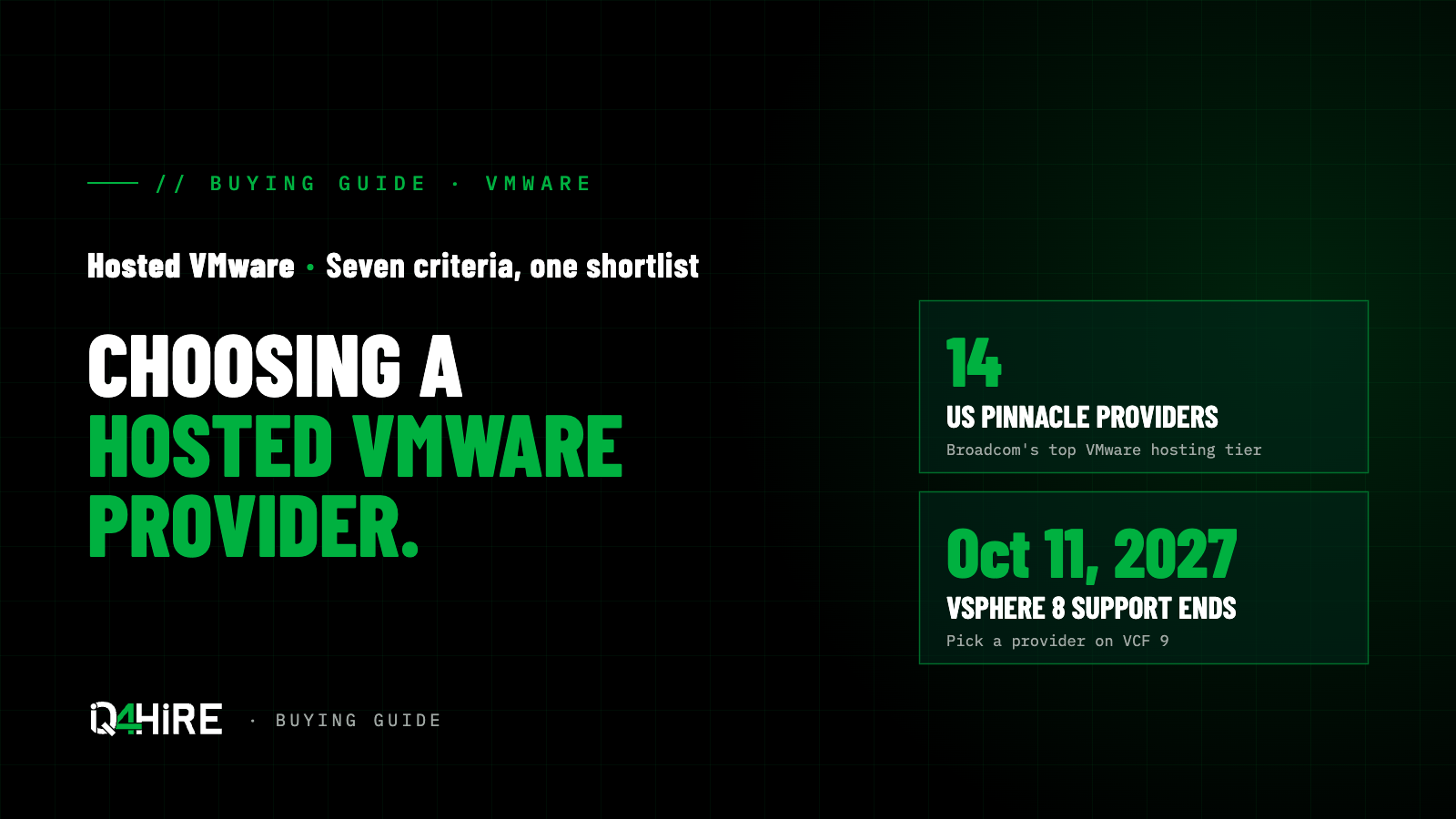
If you want to stay on VMware but stop owning the hardware, the right hosted provider is the one that is Broadcom Pinnacle, already on VCF 9 (or committed in writing), and fits your regions and compliance needs. Everything else is price and service.
This guide is for CIOs and infrastructure leaders whose VMware renewal, hardware refresh or hosting contract lands before October 11, 2027, when vSphere 8 and VCF 5.2 lose general support.
First, the terms
- VMware: the software most companies use to run many virtual servers on shared physical hardware. Broadcom bought VMware in 2023.
- VCF (VMware Cloud Foundation): Broadcom's main VMware bundle, now sold only as a subscription. VCF 9 is the current version.
- vSphere and ESXi: the core VMware products that run virtual machines. ESXi is the software on each server; vSphere is the wider product.
- vCenter: the VMware console your team uses to manage servers and virtual machines.
- NSX, vSAN and Aria: VMware's networking, storage and management tools, included in VCF whether you use them or not.
- Hosted VMware (VMware private cloud): a provider runs VMware on its own hardware in its data centers, and you rent capacity instead of owning servers.
- Broadcom Pinnacle partner: the top tier of Broadcom's VMware Cloud Service Provider (VCSP) program. Only these providers are authorized to license and host VCF for you.
- Compatibility list: Broadcom's list of server hardware certified to run a VMware version. Servers not on it can't be supported on VCF 9.
- Perpetual license: an older VMware license you bought once. Security patches for it stop when Broadcom ends support for that version.
- Colocation: renting space, power and cooling in a provider's data center for your own servers.
- DR (disaster recovery): copies of your systems in a second location so you can keep running if the first one fails.
- Hyperscaler: the big public clouds: AWS, Microsoft Azure and Google Cloud.
- HIPAA, PCI, ITAR and FedRAMP: compliance rules for health data, card payments, defense export data and U.S. government cloud services.
When hosted VMware is the right move
Hosted VMware fits when you want to keep the VMware toolchain, your people and your runbooks, and hand off the hardware.
It is usually right when:
- Your servers aren't on Broadcom's compatibility list for VCF 9, and a refresh means 20–40+ week lead times.
- Your team runs deep VMware tooling (vCenter, NSX, backup and DR built around it) and can't retrain before 2027.
- Your current hosting provider wasn't renewed by Broadcom and must move you before March 2027.
- You want licensing, support and compliance bundled into one contract instead of a separate Broadcom agreement.
Look elsewhere when:
- The goal is to cut Broadcom spend for good. Hosted VMware still follows VCF pricing; compare Nutanix, Proxmox or a hyperscaler instead.
- Workloads are already being modernized to cloud-native or SaaS within two years.
- You need a FedRAMP-authorized environment. Most hosted VMware providers don't hold one; confirm before shortlisting.
The seven criteria that decide it
Score every provider on these, in this order. The first two are pass/fail.
- Broadcom Pinnacle status (pass/fail). Pinnacle providers are authorized to license VMware Cloud Foundation and host it for you. In January 2026 Broadcom stopped renewing many other hosting providers. Only 14 US providers hold Pinnacle.
- VCF 9 status (pass/fail, or a written commitment). Providers are upgrading at different speeds. If you land on older hardware, get a written commitment to move you to VCF 9 before October 11, 2027 at no cost to you.
- Capacity you can land on now. Ask what is available today and on what hardware. A provider with room on older gear can move you fast, but only if the second move is covered.
- Regions and compliance. Data residency, HIPAA, PCI, ITAR or sovereign requirements narrow the list quickly. Get attestations, not marketing pages.
- Operating model. Fully managed versus self-managed vCenter. Decide how much of the day-to-day you want to keep.
- What else they can host. Colocation, public cloud connections, backup and DR, or Nutanix side by side. One contract can replace three.
- Exit terms. How you leave, what it costs and who owns the data and images. These are negotiable once: before you sign.
Provider shortlist by situation
All nine below are Broadcom Pinnacle partners in the IQ4hire portfolio. VCF 9 status is as of November 2026; confirm it before you sign.
| Your situation | Strong fits | VCF 9 status |
|---|---|---|
| Leave owned hardware fast, keep vCenter and VMware operations | 11:11 Systems | Ask the provider |
| Already on a VCF subscription, or your provider lost authorization | RapidScale, Lightedge | RapidScale: ask the provider · Lightedge: live |
| Regulated (HIPAA, ITAR), or may move to Nutanix later with the same provider | Expedient | Upgrading now |
| Global or multi-region, close to AWS, Azure and Google Cloud | Equinix | Partly live |
| US enterprise wanting it fully managed, including sovereign options | TierPoint, Lightedge | TierPoint: stated ready · Lightedge: live |
| Need colocation and connectivity from the same provider | Flexential | Upgrading now |
| Mid-market with HIPAA, HITRUST or PCI requirements | OTAVA | Ask the provider |
| One provider across VMware and public cloud, or Epic and SAP workloads | Rackspace Technology | Live on VCF 9.1 |
Full briefs for each provider, including constraints and sources, are on the VMware supplier briefs page.
Questions to ask before you sign
- Are you Broadcom Pinnacle today, and when does your current Broadcom agreement renew?
- What capacity is available now, and does it run on VCF 9 hardware?
- If we land on older hardware, will you commit in writing to move us to VCF 9 before October 11, 2027, at no cost?
- Who carries licensing-compliance exposure during and after the move?
- If our current provider is losing authorization, what bridge or transition terms do you offer?
- What is the total cost over the term compared with renewing direct with Broadcom?
- What are the exit terms: notice, data return, image export and cost?
- Which compliance attestations cover the exact facility and service we would use?
Contract traps and what it costs
Hosted VMware is still VMware: pricing follows Broadcom's VCF terms through the provider. It saves money mainly by removing the hardware refresh, data center costs and the staff time to run them, not by cutting the license.
Watch for:
- A second migration you pay for. Landing on older hardware now and moving to VCF 9 later, at your expense and downtime.
- Bridge programs with strings. Some require a day-one commitment to the provider's own destination platform. Fine if you've chosen; costly if you haven't.
- Bundled services you don't need. NSX, vSAN and Aria come with VCF whether you use them or not. Make sure you aren't paying twice for networking or backup you already own.
- Compliance by marketing page. "HIPAA-ready" isn't an attestation. Ask for the report that covers your facility and service.
- Soft exit terms. If leaving costs more than staying, you've signed another lock-in.
Price ranges for your environment: ask us. We compare quotes across providers on the same terms so the numbers are actually comparable.
How IQ4hire helps
Not sure hosted VMware is your path? Run the VMware Path Advisor: 11 questions, about five minutes, and you get a recommended path with the providers that fit it. If it is your path, we run the shortlist above against your requirements, get comparable quotes and negotiate the terms in this guide, with no RFP.
Related: Staying on VMware? Two Questions Decide Whether You Can and Your VMware Renewal Isn't a Renewal Anymore.