How to score your security, and your security provider
Ten parts, one rule about evidence and one calculation. The method behind the IQ4hire 4D Cybersecurity Framework, with a worked example you can repeat on your own company or a provider.
A security score means little unless someone else can repeat it. This page shows the method behind the IQ4hire 4D Cybersecurity Framework: ten parts, one rule about evidence, and one calculation. Use it on your own company, or on a provider you are thinking of hiring.
Download: How to Score (PDF) has every question, the anchors and a blank scoring sheet. Comparison Scoring (PDF) has the NIST scoring, the search record and the CIS, MITRE and ISO notes.
The ten parts
The framework has four dimensions. Together they break into ten parts, and you score each part from 1 to 5.
| Dimension | Parts scored |
|---|---|
| T, Tools | T: do your controls cover everything you run? |
| A, Authority & Seams | A1 edge to network, A2 outbound traffic, A3 behavior outside the playbook, A4 machine and AI identity, A5 handoffs between vendors and connected apps |
| S, Strike Speed & Offense | S1 time to protection, S2 offense (testing yourself first) |
| K, Keeps Adapting | K1 adapt now, K2 quantum readiness |
The one rule: score what you can show
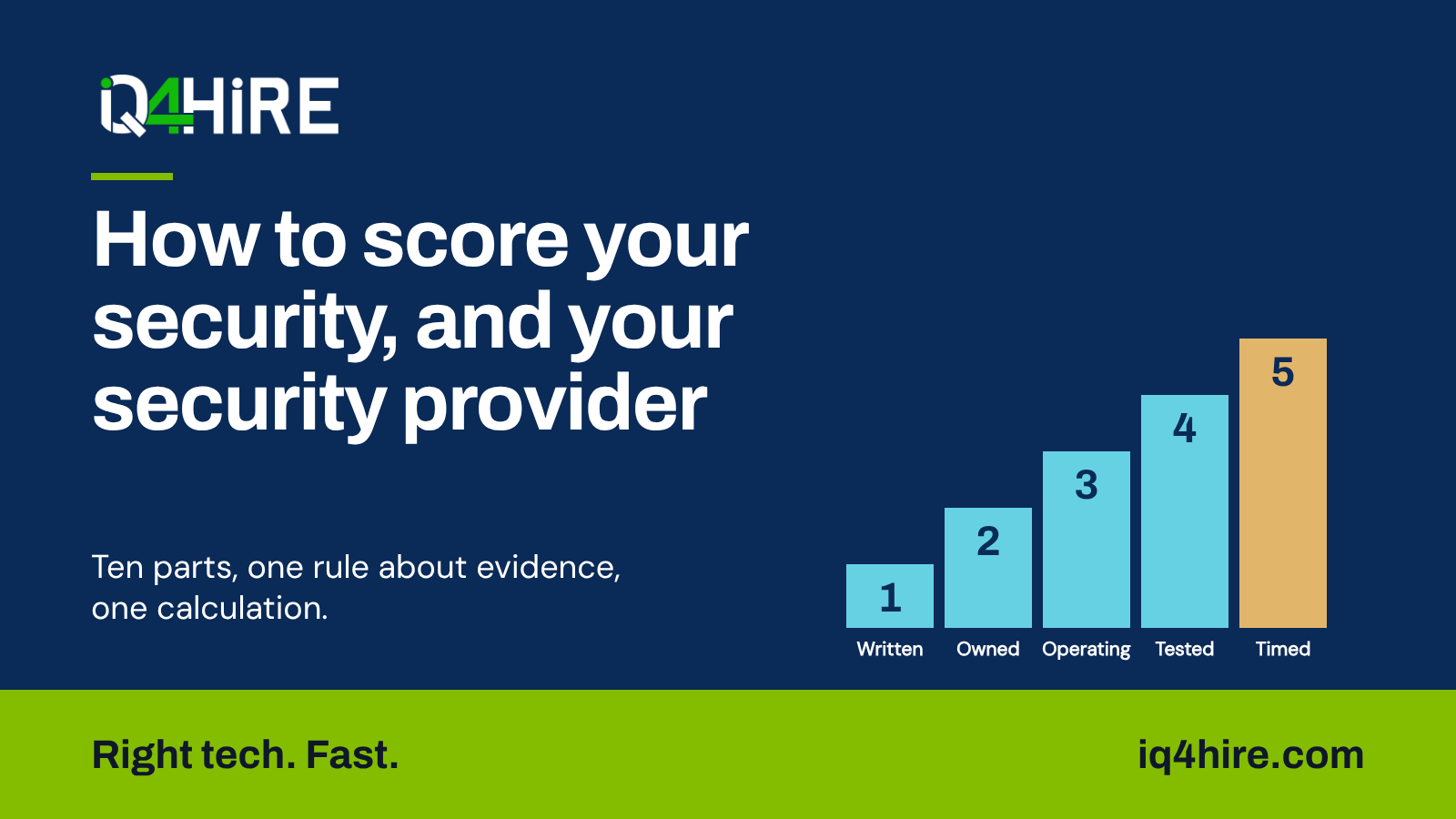
A policy states intent. An attacker tests execution. So every part is capped by its evidence, and the final score is the lower of what the answers claim and what the evidence supports. Ask every question, then say "show me."
| What you can show | The most it can score |
|---|---|
| A written policy | 1 |
| A named person who owns it | 2 |
| Proof that it runs: a log, a ticket, a setting | 3 |
| A test where someone tried to break it, with the result on record | 4 |
| A measured response time and a recent rehearsal | 5 |
The calculation
- Score each of the ten parts as a whole number from 1 to 5, after applying the evidence cap.
- Average the parts inside each dimension: A is the average of five parts, S and K the average of two.
- Multiply T, A, S and K, then take the fourth root. That is the 4D Index, on the same 1 to 5 scale.
- Name the weakest dimension next to the index. A plain average would hide it.
A worked example
A mid-size company, invented to show the method. Two scorers agreed on every row.
| Part | Claimed | What was shown | Final |
|---|---|---|---|
| T | 4 | Inventory spreadsheet, 14 months old, in use | 3 |
| A1 | 3 | Owner named in a policy; no handoff record | 2 |
| A2 | 2 | Cloud monitoring on; outbound traffic left open | 2 |
| A3 | 3 | Procedure for unknown activity; never used | 1 |
| A4 | 2 | Shared admin key in build scripts | 2 |
| A5 | 3 | Connected-app list; two apps with broad permissions | 3 |
| S1 | 3 | A person added a firewall rule on day 2; no record of who approved it | 2 |
| S2 | 2 | One outside test, before the last major change | 1 |
| K1 | 3 | Credentials rotated by hand once a year; no records | 2 |
| K2 | 1 | No encryption inventory | 1 |
T is 3. A is 2.0, S is 1.5 and K is 1.5. The 4D Index is 1.9, and the weakest dimensions are S and K. The first moves: run a one-hour rehearsal of the 3 a.m. call, pre-approve one protection rule and name who holds the kill switch, and start an encryption inventory ranked by how long each kind of data must stay secret. Without the evidence cap, the claimed levels would have produced a higher index.
Using it on a provider
- Ask for the evidence, not a description: the last drill record, and how long protection took the last time.
- Score only what the contract delivers. A capability that costs extra counts as absent until it is in the order.
- Compare providers on the weakest dimension first, then the index. Handoffs (A5) and time to protection (S1) usually decide the outcome: who is in charge when the provider's alert reaches your team, and does something stop the attack automatically or wait for a person?
How we tested it against the NIST framework
We scored the NIST Cybersecurity Framework 2.0 against the same ten parts with two scorers, first from the document alone and then with NIST's own online examples. The index came out at 1.48 and 1.70 from the document, and 2.28 with the examples. Every reading is below the "partial" mark of 3. The full scoring is in the comparison paper so that you can repeat it or disagree with it.
What we do not know
The method is proposed, not yet proven. We have not tested it on real companies, and we have not measured how far two scorers differ in practice. The anchors and the reading bands are our standard, and we will revise them after the pilot. The second scorer so far is an AI model, and human scorers are the next step.
Score ten parts from 1 to 5. Cap each by the evidence you can show. Multiply the four dimensions and take the fourth root. Name the weakest one. Do it with two scorers.
See where you stand. Book a security evaluation, where we ask to see the proof behind each answer.
Suppliers don't pay to be listed. If you buy through us, the supplier you choose pays IQ4hire, and we tell you before work begins.
IQ4hire is not affiliated with, endorsed by or sponsored by NIST, the Center for Internet Security, MITRE or any other organization named on this page. Product, framework and company names belong to their owners and are used only to identify the works discussed. The scoring is IQ4hire's own method and opinion, and it is open to anyone to repeat or dispute.
Series
The IQ4hire 4D Cybersecurity Framework- 1. The IQ4hire 4D Cybersecurity Framework
- 2. How to score your security, and your security provider