Every term on this page, in one place.
- Attestation
- A formal statement that something is true, made by someone who can be held to it. An independent one comes from an outside firm. A self-attestation is one you sign yourself.
- CIS Controls
- A prioritized list of security safeguards published by the Center for Internet Security. Providers use it for practical, step-by-step detail.
- CMMC (Cybersecurity Maturity Model Certification)
- A US Department of Defense program. Defense contractors must meet cybersecurity requirements and show it, by self-assessment or by an outside assessor, depending on the level.
- Co-management
- You and the provider both have access to the same security tools and share the work.
- Containment
- Stopping an attack from spreading, for example by isolating a computer or blocking an account.
- Dwell time
- How long an attacker is inside your systems before anyone finds them.
- EDR (endpoint detection and response)
- Software on computers and servers that records activity and flags or acts on threats. Someone still has to watch it.
- Endpoint
- A computer, server, phone or other device that connects to your network.
- Eradication
- Removing the attacker and whatever they left behind.
- Forensics
- Investigating what happened, and preserving the evidence.
- Hot and cold log storage
- Logs are the records your systems keep. Hot storage keeps recent logs ready to search fast. Cold storage keeps older logs more cheaply and retrieves them more slowly.
- Incident response
- The plan and the work for handling an attack, from first alert to recovery.
- ISO 27001
- An international standard for running an information security management program. Organizations can be audited and certified against it.
- MDR (managed detection and response)
- A service where another team watches your systems around the clock, investigates alerts and acts for you.
- MFA (multifactor authentication)
- Logging in with something more than a password, such as a code from your phone.
- MITRE ATT&CK
- A public catalog of the tactics and techniques attackers use, used to test whether detection covers real attacker behavior.
- MSP (managed service provider)
- A company that runs your day-to-day IT for a recurring fee: help desk, patching, backups.
- MSSP (managed security service provider)
- A company that runs security for you, usually through a round-the-clock security operations center.
- MTTD and MTTR (mean time to detect and respond)
- Averages of how long it takes to spot a threat and to respond to it. Ask how each is measured, because "response" can mean acknowledged or contained.
- NIST AI Risk Management Framework
- Voluntary US guidance for managing AI risk, organized as govern, map, measure and manage.
- NIST Cybersecurity Framework 2.0
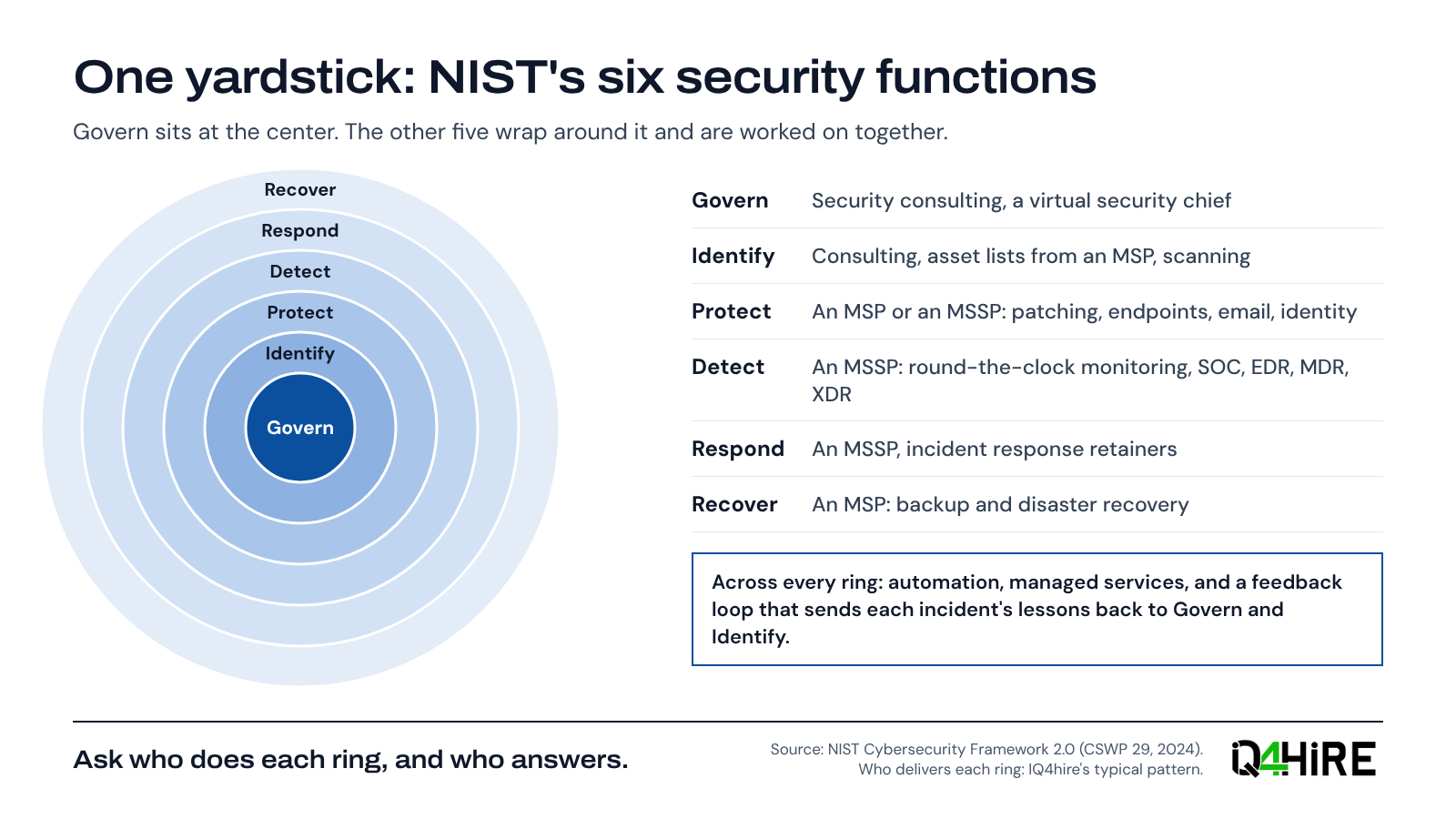
- A voluntary US government framework that describes security as six functions: govern, identify, protect, detect, respond and recover. It is a common vocabulary, not a certification.
- NIST profile
- A custom list of the security outcomes an organization wants from each function, used to measure the gap between where it is and where it wants to be.
- NOC (network operations center)
- The team that monitors and maintains your network and systems for availability, as opposed to security.
- Penetration test versus vulnerability scan
- A scan is automated and checks for known weaknesses. A penetration test is people carrying out an authorized simulated attack to prove what can be broken.
- Phishing and business email compromise
- Phishing is a fake message meant to trick you. Business email compromise is a fake message, often posing as an executive or a vendor, meant to get money or data.
- Prompt injection
- Hidden instructions in text, a document or a web page that steer an AI system into doing something its owner did not intend.
- RACI
- A table that names who is Responsible, Accountable, Consulted and Informed for each decision.
- Remediation
- Fixing the root cause and the weakness, not only stopping the attack.
- RIR (rapid incident response)
- Expert help during an active attack: containment, forensics and recovery, often bought as a retainer.
- RMM (remote monitoring and management)
- Software an MSP uses to watch, patch and manage your devices remotely.
- Service level agreement (SLA)
- The written promise about what the provider will deliver, how fast, and the remedy if it does not.
- SIEM (security information and event management)
- A system that collects logs from many sources, connects the dots and raises alerts.
- SOAR (security orchestration, automation and response)
- Software that runs the repeatable steps of a response automatically, using prewritten playbooks.
- SOC (security operations center)
- The team, and sometimes the room, that monitors for threats around the clock.
- SOC 2
- A report by an independent CPA firm on a service provider's controls, tested against standard criteria. A Type 1 report describes the controls at a point in time. A Type 2 report tests them over a period.
- Threat hunting
- People searching for attackers that automated tools missed.
- Threat intelligence
- Information about attackers, their methods and what they are targeting now, used to improve detection.
- vCISO (virtual chief information security officer)
- A part-time or outsourced security leader who sets strategy, policy and priorities.
- XDR (extended detection and response)
- A platform that watches endpoints, network, cloud, email and identity together, so it can connect clues across them.
- Zero trust
- A design principle: no user, device or system is trusted by default, and every request is checked.