Insights
“I can build that.” In the age of AI, who owns it after launch?
AI made software easier to build, not cheaper to own. Six questions to answer before you build, buy or configure, and who owns the result.
AI has made software easier to create. It has not made software cheaper to own. A team can build a working prototype in days, but someone has to secure, support, upgrade and eventually retire it for years. So when someone says "I can build that," the first question is not whether they can. It is who will own it after launch.
Build, buy and own are three decisions
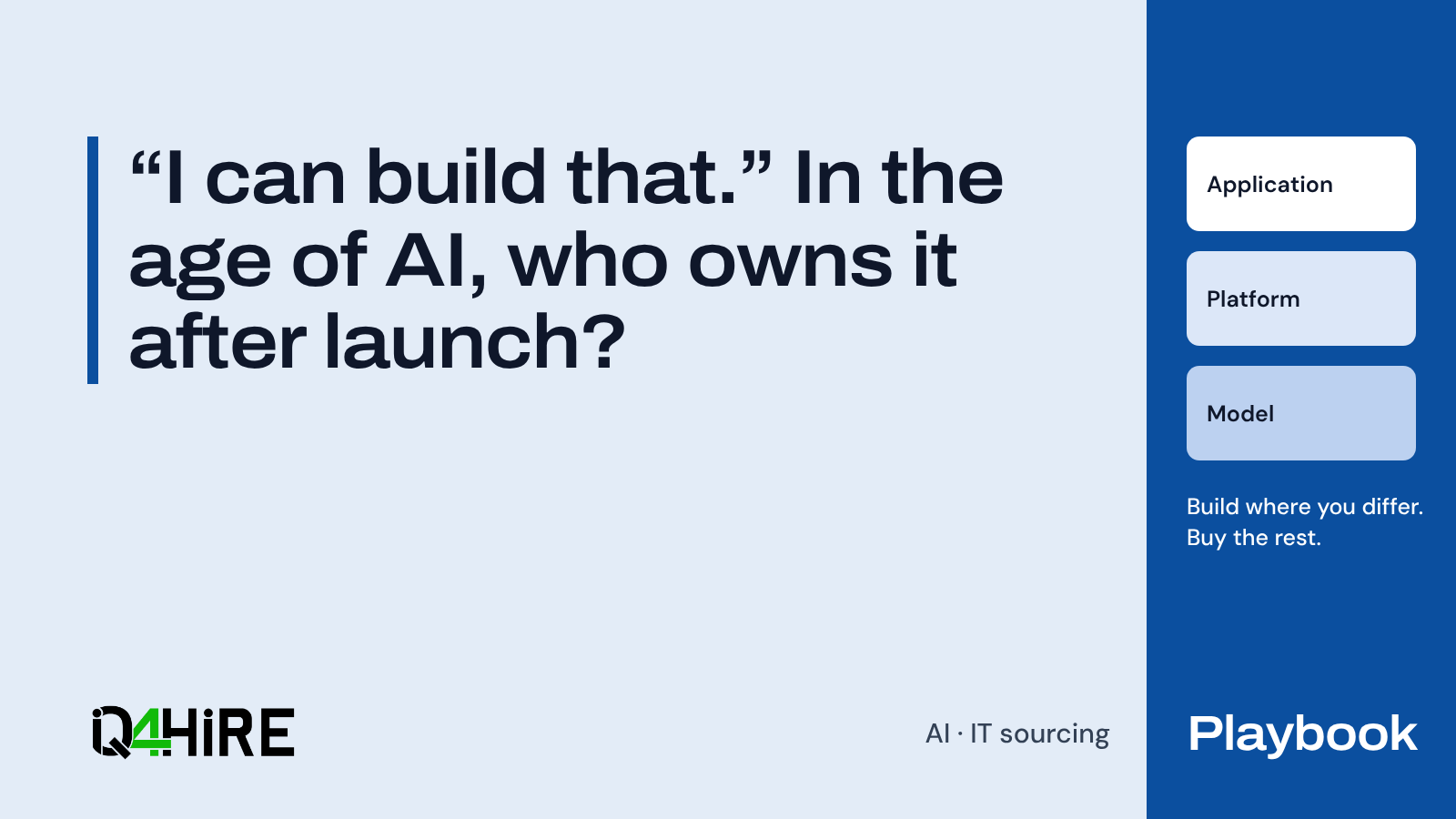
An AI solution has at least three layers, and you can decide each one differently:
- The model is the trained engine: a prediction model, a large language model or another system that generates or interprets information.
- The platform is where the model runs and connects to your data, systems and people. It supplies security, monitoring, scaling and audit trails.
- The application is the workflow people use: your rules, knowledge, approvals and experience.
The expensive mistake is treating the three as one decision. Companies spend months rebuilding platform features that already exist, and underfund the application work that makes them different. A common right answer is to buy the model and the platform, and build the application.
 (opens the full-size image in a new tab)
Three kinds of AI, three different answers
Machine learning: build when your data is the advantage. It answers "what is this?" or "what is likely to happen?" Think fraud scores, churn forecasts and failure predictions. The model code is small. The data pipelines around it become the bigger source of technical debt, and the model drifts as customers and markets change.
Large language models: buy the model, own the application. Training a frontier model from scratch is not a sensible choice for most companies. The decisions that matter are which model to use, where it runs, what data it may see and which applications deserve custom work. For general productivity, a finished product is usually right. Build when your own contracts, policies or service history create the value, and keep that custom layer thin, because models and APIs change fast. Prompts and one-off integrations get stranded when a model is retired.
Agents: buy the plumbing, own the policy. An agent decides what to do, calls tools and changes systems. That makes identity, permissions, approval limits and audit trails central. One task can trigger many model calls, so costs multiply, and behavior can break when the model or a connected system changes. Use the agent features in platforms you already run, and build custom orchestration only for work that is yours alone.
It is a spectrum, not a coin flip
A mature company keeps four options open: build, buy, configure or combine existing services, and replace or retire. Sometimes you buy a product. Sometimes you configure a platform. Sometimes the right move is to retire an application that no longer earns its keep.
Two recent signals show why neither extreme is safe. A group called OccupySaaS is using AI to build open-source, self-hosted alternatives to Auth0 and Salesforce. Its identity project, ZeroAuthy, reached a first release candidate on November 4, 2026, and the group calls it an early preview. Its Salesforce alternative, SalesCompel, says in its own README that it is not production-ready. So this is a sign of what is becoming possible, not proof that subscription software is going away.
The second signal comes from the other side. On November 10, 2026, Adobe announced local integrations that would let outside AI agents work with project files in Photoshop, Illustrator, Premiere and After Effects. According to Adobe, they are planned for private beta in early 2027. Established vendors are opening their products to agents. That makes the platform's connections, controls and data model part of what you buy.
So do not assume a subscription is safe because the vendor is well known. And do not assume an AI-built replacement is cheaper because a prototype came together fast. Compare capability, portability, operating burden, security and total cost.
 (opens the full-size image in a new tab)
The hidden cost is ownership
More people can now create more applications, scripts, integrations and agents. That is good for speed. It also creates software with no named owner, no support path, no list of dependencies, no tests, no monitoring and no backup plan. It may use production data or credentials without a proper access model.
The bigger risk is the application that succeeds. A useful prototype attracts users. Users build habits around it. A department starts to run a real process on it. Then the creator moves on, and nobody has accepted responsibility for it. The AI tool that wrote the code does not own it. The model provider does not own it. The business does.
This reaches insurance and compliance too. According to security vendors' guides, cyber-insurance applications commonly ask about multifactor authentication, patching, tested backups and an incident response plan, and some ask for evidence of the security tools in use. Requirements vary by carrier, so your broker's application is the authority. An unmanaged app does not by itself void coverage. But a company that cannot say what software it runs may struggle to prove the controls it attested to. "AI built it" is not a control.
 (opens the full-size image in a new tab)
A demo is not a production system
A demo shows something can work. It does not show it can run the business. In a customer-facing AI system, the gap includes response speed, interruptions and odd cases, handoff to a person with full context, links to your CRM and ticketing, identity checks, compliance, guardrails and peak volume.
The gap has a price, which matters to the CFO. One vendor business case I reviewed, for a retailer handling about 430,000 calls and chats a year, estimated about $670,000 in annual savings and a production lead of fourteen months for a platform approach over a custom build. At about $56,000 a month, that lead is worth close to $800,000 in savings not received. That is a vendor's anonymized model, not an independent estimate, and your results will differ. The principle holds anyway: count the value of benefits you do not get while a build is still underway. The full case is in our contact center AI buying guide.
 (opens the full-size image in a new tab)
Who runs it when it is live?
The question reaches past the application. Do you want to own security, hosting, infrastructure and managed IT for something you built? If your managed service provider supports your standard systems, will it support a custom application? Its scope, tools and service levels may not cover software you wrote yourself.
Before you build, confirm who hosts and secures it, who monitors, patches and backs it up, who handles incidents, whether your provider will accept it into its supported environment, and what that adds in cost. If nobody can, you must bring the work in house, pick another provider, or rethink the build. Open source changes the license and your control. It does not mean you must staff every capability around it.
The CIO's job: make safe easier than unsafe
Banning business-led development wastes the opportunity and pushes it underground. The CIO's job is to make the safe route the easy one: approved tools and model access, patterns for identity and data, an inventory of applications and agents, risk-based review, and a clear path to support, transfer or retire what gets built.
Not every prototype needs an architecture board. But every application that reaches production needs two named owners:
- A business owner, accountable for the outcome, the value and the decision to keep investing.
- A technical owner, accountable for security, reliability, documentation, dependencies and upkeep. This can be an internal team or an accountable provider.
Neither role goes to "IT" as an idea, and neither goes to an AI tool. Review each application on a schedule, and when it stops earning its keep, retire it on purpose: remove access, keep the records you must keep, move the data and shut down what it depended on.
 (opens the full-size image in a new tab)
Six questions before you approve a build
- Is it different? Does it give you an advantage competitors cannot easily buy? If not, why build it?
- What already exists? Can a mature platform, extension or open-source project provide most of it? Can you configure instead of rebuild?
- What does it cost in full? License, setup, integration, engineers, hosting, support, security, upgrades, testing, maintenance, delay and eventual replacement.
- How fast does the technology change? The faster the model or API moves, the thinner your custom code should be.
- Who owns it? Name both owners, the support terms and the retirement plan before launch.
- What is the risk? Data sensitivity, access, outside dependencies, audit needs, rules you must follow and the evidence insurers and regulators will ask for.
Score every option the same way, the build included, against requirements you wrote before the demos. A report, a demo or a polished sales deck can inform the choice. None replaces testing the fit in your environment.
When building is right
Build when the workflow is unique and no platform supports it, when your own data or intellectual property is the advantage, when a hard constraint rules out the products on offer, when the economics clearly favor it over the expected life of the system, or when you already have the team and discipline to run it. Even then, reuse mature foundations, keep custom code thin where technology moves fast, and fund the whole lifecycle, not only the launch.
What this means
AI should change how you make technology decisions. It should not change the economics. Build what makes you different, buy what makes you fast, configure what already works, and never build something you cannot responsibly own. So when someone says "I can build that," the next question is: who will own it after you've built it?
How we are paid: Suppliers don't pay to be listed. If you buy through us, the supplier you choose pays IQ4hire, and we tell you before work begins. Where you want our experience on its own, such as an assessment of a build decision, that is consulting, on a fee.
Related: Build the difference, buy the rest (ecommerce). Digital commerce solutions. Our AI practice.
Sources
- Adobe, November 10, 2026: Creative Cloud agentic workflows and local MCP integrations
- OccupySaaS and the SalesCompel repository
- Huntress: cyber insurance requirements (a security vendor's guide; check your carrier's application)
- IQ4hire: Adding AI to the contact center you already have (vendor business case, anonymized)